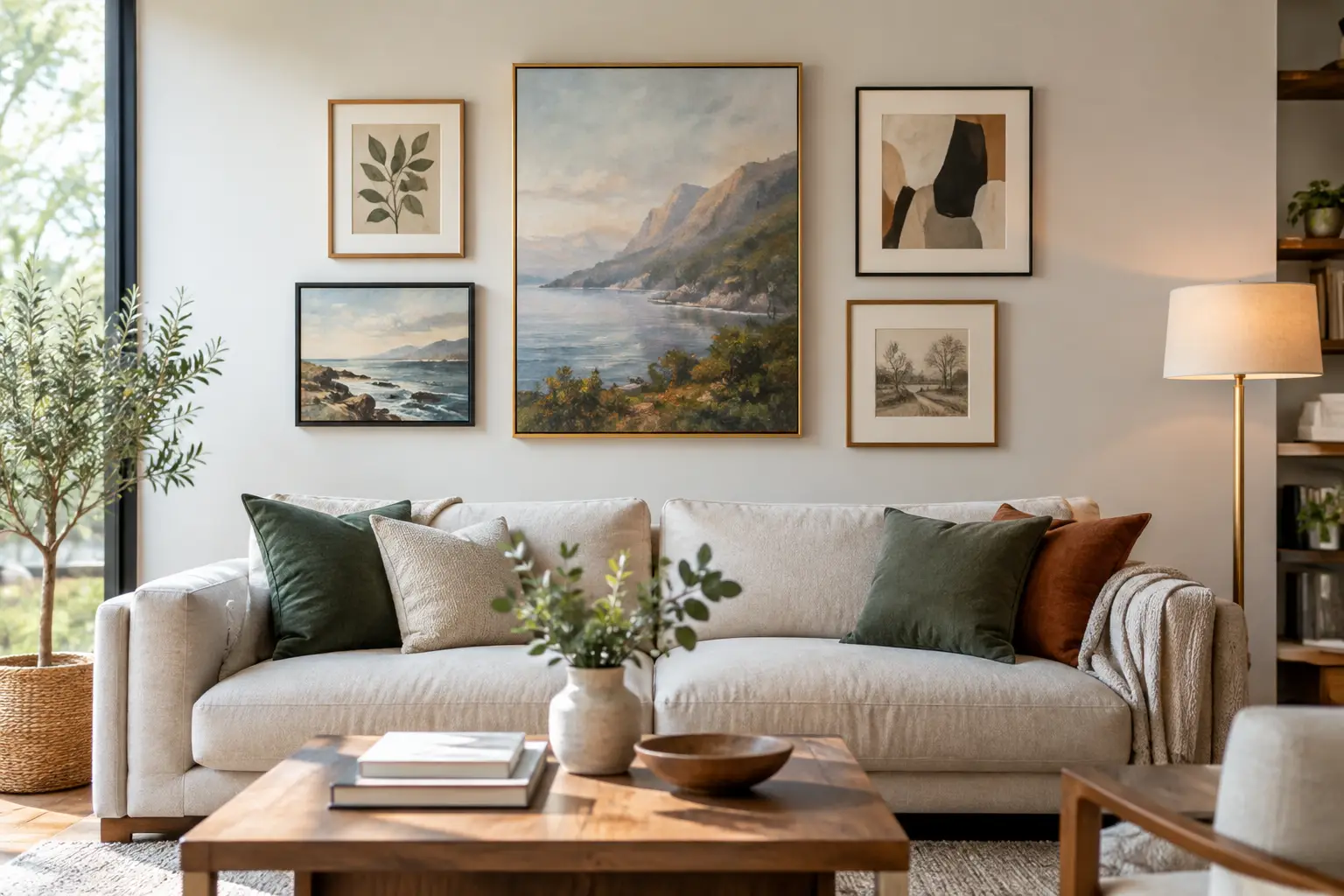
Gallery Artwork for a Personal Interior
A room may be beautifully finished and still feel anonymous. Gallery artwork changes that condition. It introduces a point of view that cannot be ordered from a catalog: a gesture, a pulse of color, a presence that asks something of the eye and gives something back over time. For the collector, art is not a final layer of decoration. It is often the first true statement of identity.
A work chosen with conviction can alter the scale of a room, the atmosphere of an arrival, and the way a home is remembered. It becomes part of the private theater of daily life: seen in morning light, encountered after travel, reflected in a mirror, quietly holding its ground through changing seasons.
What Gallery Artwork Brings to a Room
The distinction between decorative imagery and gallery artwork is not simply a matter of price, size, or frame. It is a matter of authorship. An original work carries the marks of a hand, an intelligence, and a decision made in real time. Its surfaces preserve evidence of its becoming.
That evidence creates depth. A painting may contain a line that becomes visible only in late afternoon, a field of pigment that shifts from velvet to fire, or an imperfect edge that makes the entire composition feel alive. These are not incidental details. They are the qualities that let a work remain compelling long after the first impression has passed.
For a private residence, the right piece does more than coordinate with furnishings. It establishes emotional temperature. A luminous abstract composition can bring sensuality to a restrained bedroom. A figurative work may lend a salon a sense of witness and mythology. A quietly tonal canvas can make a dramatic architectural space feel inhabited rather than merely impressive.
The question is not, "What matches this room?" It is, "What deserves to live here?"
Choose Art Before the Room Becomes Too Finished
Many interiors lose their possibility when every surface, textile, and finish has already been decided. Art is then asked to solve a scheme rather than lead one. The result is often polite, correct, and forgettable.
A more considered approach begins with one work that has real authority. Let its palette suggest a silk cushion, a lacquered table, a wall finish, or the unexpected lining of a curtain. This does not mean reproducing every shade in the painting across the room. Repetition can flatten its force. Instead, allow the artwork to create a conversation among materials.
A saturated work may need surrounding quiet: plaster, stone, dark timber, ivory upholstery, or a single pool of focused light. A delicate composition can withstand richer surroundings if its framing gives it sufficient presence. There is no universal formula. A minimal interior may need a work of unapologetic drama, while an ornate room may be transformed by a painting of radical restraint.
Collectors with several residences often benefit from treating each property as a distinct chapter rather than trying to repeat the same look everywhere. A coastal retreat can hold works with air, movement, and fluid color. A city apartment may invite sharper contrasts and more concentrated scale. A home in the country can carry pieces with earth, memory, or a slower visual rhythm. The collection remains coherent through sensibility, not duplication.
Scale Is a Matter of Presence
A small work can be exquisite, but it should not be made to perform the role of an architectural anchor. Above a long console, a mantel, or a generous sofa, a single significant work often has more authority than a scattered arrangement of lesser pieces.
Conversely, an intimate painting can be profoundly affecting when placed where one encounters it closely: beside a dressing table, at the end of a corridor, within a library, or near a chair reserved for reading. These placements create private encounters. The work does not need to announce itself to everyone who enters.
When considering scale, stand at the distance from which the artwork will most often be seen. Notice the wall around it, not only the object beneath it. Empty space is not absence. It gives the piece room to breathe and signals that it has been chosen, not merely placed.
The Frame, the Light, and the Ritual of Looking
A frame can either clarify a work or diminish it. It should never compete for attention simply because it is ornate or expensive. For certain paintings, a refined gilded frame brings warmth and ceremony. For others, a clean shadow gap or understated wood profile protects the work's contemporary clarity. The decision depends on the painting's language and the architecture around it.
Lighting deserves equal care. General ceiling light rarely reveals artwork at its best. A dedicated, well-aimed picture light or discreet adjustable fixture can draw out color and texture without creating glare. Avoid direct sun when possible, particularly for works on paper, silk, or other light-sensitive materials. Protection is part of stewardship.
Then comes the element no designer can supply: time. Live with the work before deciding it must be moved. The relationship between art and interior shifts as daylight changes, as flowers arrive, as the room fills with guests, as the house becomes quiet. What feels unexpected on the first day may become essential by the tenth.
From Wall Art to a Living Collection
The most distinctive collections do not stop at the wall. They allow an artistic language to move through the home and into the life of the person who owns it. A painting can find an echo in a silk panel, a hand-painted textile, a sculptural object, or a garment that carries the same world beyond the room.
This is where collecting becomes intimate rather than accumulative. The client is not acquiring objects with a common color story. She is building a personal mythology. The artwork seen above the fireplace may reappear as luminous silk at a private dinner, then return home with new associations attached to it. When worn, the artwork is no longer observed. It moves. It becomes.
For Violeta Lucce, this continuity is central: an original painted language can move from canvas into silk, interiors, and art couture while retaining its sense of origin. Such works make particular sense for clients who see their wardrobe and their rooms as expressions of one sensibility, not separate purchases made for separate occasions.
There is a trade-off, of course. A highly unified collection requires discernment. If every object speaks at the same volume, the home can feel staged. Leave room for contrast: an inherited chair, a vessel found during travel, an antique with a different history, a field of unadorned wall. The aim is not a branded environment. It is a world with a soul.
Commissioning a Work for an Exceptional Space
A commission offers a rare opportunity to shape an artwork around a particular life, but it should not be treated as a request for matching colors. The strongest commissions begin with atmosphere: the feeling of the space, the collector's private references, the architecture, the emotions that belong there.
Share images of the room, certainly, but also share the less obvious material. A remembered landscape. A piece of music. The character of a woman in the family. A beloved city at night. A wedding dress, a garden, a passage from a book. These fragments give the artist a richer field from which to create something that does not merely fit the space, but belongs to it.
For hospitality, yachts, and private residences, commissioning can also create a signature encounter. A guest may not remember every finish in a suite, but they will remember the artwork that made them pause. In such settings, art becomes part of the invitation: a quiet declaration that this place has its own language.
The work worth choosing is rarely the work that flatters every room or pleases every visitor. It is the one that continues to reveal its character, and perhaps a little of yours, each time you return to it.


Comments